Should You Follow Your Heart or Your Head? Here's What Psychology Actually Says
You know that feeling. Your heart is completely sure. Your head immediately lists seventeen reasons why that's a bad idea. Or the other way around — everything makes perfect logical sense, but something in you just won't settle. You go back and forth for days, ask everyone you know, and still feel stuck.
Here's what nobody tells you: the conflict isn't between your heart and your head. It's between two different parts of the same brain. And once you understand how they work — and when to trust which one — making difficult decisions becomes a lot less exhausting.
What's Actually Happening When Your Heart and Head Disagree?
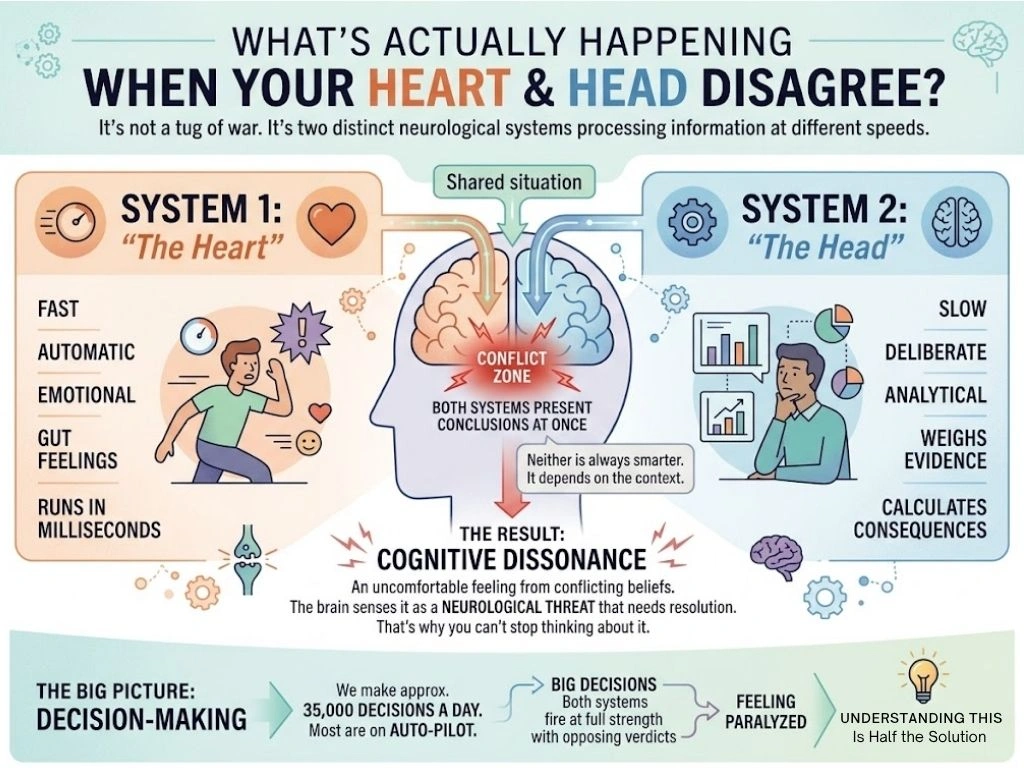
It's not a tug of war between emotion and logic. It's two neurological systems processing the same situation at different speeds — and arriving at different conclusions.
Nobel Prize-winning psychologist Daniel Kahneman identified these as System 1 and System 2. System 1 is fast, automatic, and emotional — it works in milliseconds and produces that immediate gut feeling. System 2 is slow, deliberate, and analytical — it weighs evidence, calculates consequences, and takes its time. Both systems run simultaneously. The conflict you feel is simply both of them presenting their conclusions at once, each convinced it's right.
Neither is always smarter than the other. That's the key insight most people miss entirely.
There's also a psychological phenomenon called cognitive dissonance — the genuinely uncomfortable feeling that arises when two conflicting beliefs exist in your mind at the same time. When heart and head disagree, your brain experiences this tension as a real neurological threat that needs resolution. That's why you can't stop thinking about it. Your mind isn't being dramatic. It's doing its job.
We make an estimated 35,000 decisions every single day — most on complete autopilot. It's only the bigger ones, where both systems fire at full strength with opposing verdicts, that create this paralysis. Understanding that is already half the solution.
Does It Actually Matter Which One You Follow?
Yes — but the right answer depends entirely on the type of decision in front of you, not on some universal rule.
Research consistently shows that for long-term structural decisions — career changes, where to live, major relationships, significant financial commitments — logical, analytical thinking tends to produce outcomes people are more satisfied with over time. These are decisions whose consequences stretch across years, sometimes decades. Emotion in the moment is not always a reliable map for where you'll want to be five years from now.
But for identity-based decisions — creative choices, values-driven commitments, decisions about the kind of person you want to be — the heart often has better information. Logic can tell you what makes sense. It cannot always tell you what matters to you. Decisions made entirely from logic, without emotional alignment, frequently feel hollow even when they succeed on paper. You can build an impressive life on pure practicality and still feel strangely empty in it.
The most effective decision-makers don't choose between heart and head. They use both — deliberately, and with an understanding of which one to weight more heavily depending on what's actually at stake.
Is Gut Feeling Real, or Is It Just Another Word for Emotion?
Gut feeling is real — but it is not the same as emotion, even though the two can feel nearly identical in the moment.
Researchers at the University of New South Wales demonstrated this in a controlled study where participants were shown subliminal images — emotional content they couldn't consciously see or identify. Their bodies responded physiologically even without awareness, through measurable changes in skin conductance. More importantly, their decision-making improved. The gut feeling was not imagination. It was the brain processing real information at a speed that bypassed conscious thought entirely.
Gut feeling, at its best, is compressed wisdom — the brain drawing on all your past experiences, pattern recognition, and implicit knowledge to deliver a verdict faster than you can think it through. You don't know why you feel it. That's because it happened before the "knowing" part of your brain had time to catch up.
But gut feeling has real limits too. Research from Boston College found that intuitive decision-making is most reliable when you have genuine expertise in the subject — what researchers call domain knowledge. Outside your area of experience, the gut is much more easily hijacked by wishful thinking, confirmation bias, or simple fear. The gut feeling that says "don't take that job" can be wisdom. It can also be anxiety dressed up as wisdom. Learning to tell the difference is the whole skill.
A useful distinction: wisdom feels quiet and consistent, even when inconvenient. Fear feels loud, urgent, and tends to get stronger the more you try to reason with it.
How Do You Actually Make a Better Decision When You're Stuck?
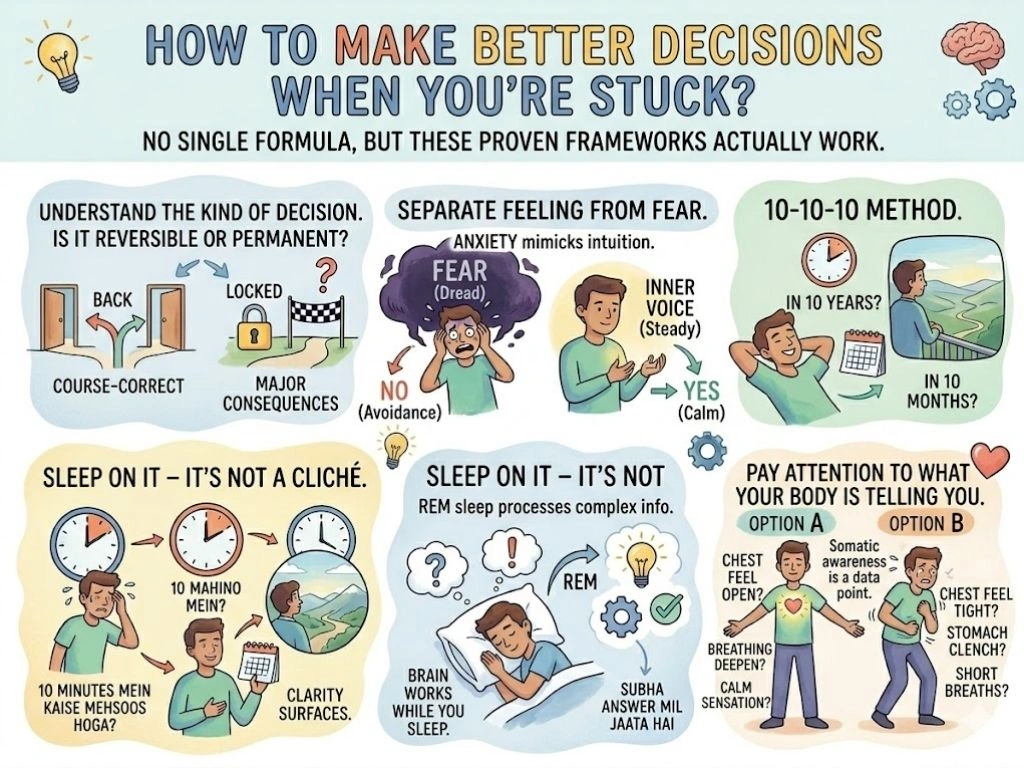
There's no single formula — but there are several well-tested frameworks that work because they're designed around how the brain actually processes difficult choices, not how we wish it did.
Start by understanding what kind of decision this actually is
Before anything else, ask yourself: is this reversible or permanent? Is it primarily about values and identity, or practical outcomes? Is it time-sensitive or can it wait a few days? These questions matter because they determine which system deserves more weight in this specific situation. A decision you can revisit and course-correct in six months is categorically different from one with permanent consequences. Treating them the same way is one of the most common decision-making mistakes people make.
Separate the feeling from the fear
This is perhaps the most important step — and the one most people skip. A very large proportion of "heart says no" situations aren't the heart speaking at all. They're anxiety speaking. Fear of failure, fear of judgment, fear of change, fear of being wrong — all of these can mimic intuition almost perfectly. The test: does the resistance feel like dread and avoidance, or does it feel like something quieter and steadier — a calm, persistent sense that this isn't right, even when you can't explain why? Dread is almost always fear. The quieter feeling is usually worth listening to.
Use the 10-10-10 method
Journalist Suzy Welch developed this framework, and it's become widely used in decision coaching because it works. Ask yourself three questions: How will I feel about this decision in 10 minutes? In 10 months? In 10 years? This forces your brain out of the intensity of the present moment and into three different time horizons simultaneously. Decisions that feel absolutely terrifying right now often look completely manageable from a ten-year distance. And decisions that feel easy and exciting right now sometimes look very different once the initial emotion fades. The method doesn't tell you what to decide. It gives you three different vantage points to decide from.
Sleep on it — this is not a cliché
Sleep science research consistently shows that the brain continues processing complex, unresolved information during sleep — particularly during REM cycles, which are associated with emotional memory consolidation and creative problem-solving. Many people wake up with unexpected clarity on decisions they couldn't resolve the night before. If you've been going back and forth for several days, the problem is often not that you don't have enough information. It's that your brain needs time away from actively thinking about it. Give it a night. The answer often surfaces without being forced.
Pay attention to what your body is telling you
There is a well-documented practice in psychology called somatic awareness — the deliberate tuning into physical sensations as a source of information. When you mentally rehearse choosing option A, does your chest feel open or tight? Does your stomach settle or clench? Does your breathing deepen or shorten? The body registers decisions before the conscious mind has finished deliberating, and it often registers them honestly. This isn't mysticism — it's the body's stress response system responding to what the mind is processing. It's not foolproof, but it is a real data point that most analytical thinkers completely ignore.
Why Do Some People Always Follow Their Heart and Still Make Great Decisions?
_1780032652.webp)
Because what looks like following the heart is actually a highly trained intuitive system — built through years of emotional experience, self-awareness, and reflection.
This comes down to emotional intelligence, or EQ — the ability to recognise, understand, and manage your own emotions without being controlled by them. People with high EQ don't suppress their feelings when making decisions. They listen to them with a degree of critical distance. They ask themselves: is this feeling giving me information about the situation, or is it giving me information about my fear? That distinction, consistently applied, is what separates emotionally intelligent decision-making from impulsive decision-making — even when both look like "following your heart" from the outside.
The good news is that EQ is not a fixed personality trait. It is a skill, and it responds to deliberate practice. Journaling about past decisions, mindfulness practice, and honest self-reflection after things go wrong or right — all of these build the capacity over time. The people who seem to have a natural gift for this have usually just done more of that work, often without labelling it as such.
What Happens When You Constantly Override Your Heart With Logic?
You become very efficient at making defensible decisions — and quietly miserable about many of them.
This is one of the most common patterns behind what people describe as a midlife crisis, or a sudden need to completely change direction despite apparent external success. Every decision along the way was rational. Every choice could be justified. But the accumulation of consistently overriding what they actually wanted — for what made sense, looked good, or seemed responsible — eventually creates a gap between the life someone has built and the life they actually want to live.
The heart isn't irrational. It tracks meaning, identity, alignment with personal values, and joy — things that don't always show up in a pros and cons list but matter enormously to long-term wellbeing. When it gets overridden consistently, it doesn't go quiet. It gets louder in other ways — restlessness, low-grade dissatisfaction, a persistent sense that something important is missing even when everything looks fine from the outside.
The goal isn't to follow your heart blindly or your logic exclusively. It's to build an ongoing relationship between the two where neither gets permanently silenced.
If You're Spiritually Inclined — A Note on Seeking Inner Clarity
Across virtually every major spiritual tradition — Hindu, Buddhist, Sufi, Stoic — there exists a concept of inner knowing that is understood as distinct from both emotion and rational thought. It goes deeper than both. In Sanskrit it is called viveka — discernment. In Buddhist philosophy it is prajna — wisdom. In the Stoic tradition it is logos — right reason aligned with nature. Each tradition points to the same basic idea: that beneath the noise of what you feel and what you think, there is a quieter level of knowing that becomes accessible when the mind stills.
This is not mysticism for its own sake. It's a recognition that the heart-head conflict is often loudest precisely because both systems are running on stress, urgency, and external pressure. Creating genuine stillness — even briefly — can cut through that noise in ways that no amount of additional analysis will.
Meditation, mantra repetition, and breathwork are all documented practices for accessing this kind of clarity. They work not by giving you answers, but by reducing the interference between you and what you already know at some level.
A Quiet Word on the Ganesh Rudraksha
_1780032666.webp)
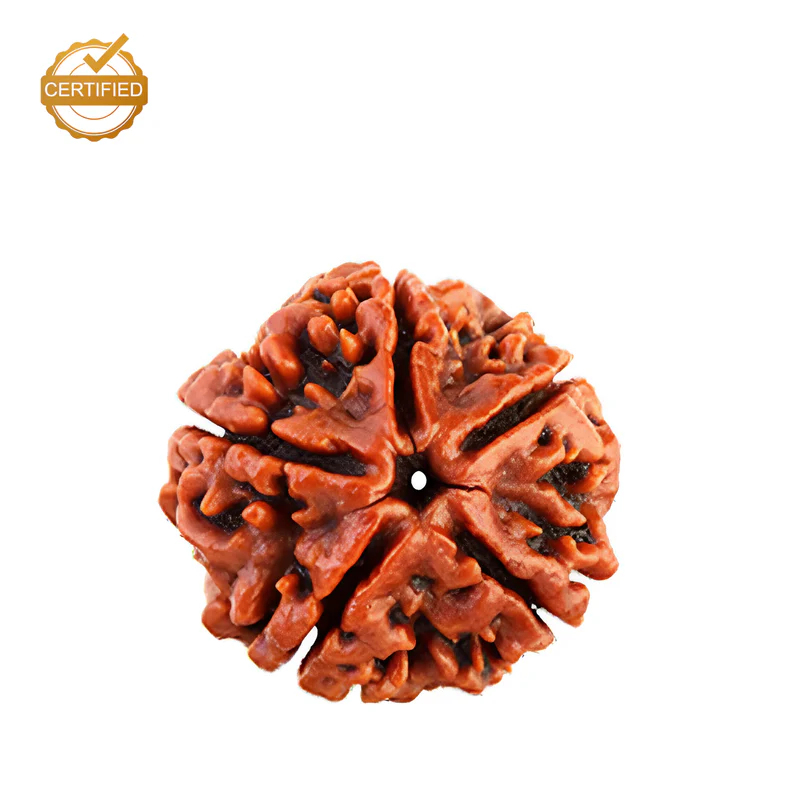
For those who already engage with spiritual tools, the Ganesh Rudraksha is worth knowing about in this context. In Hindu tradition, Lord Ganesha is the deity of wisdom, new beginnings, and — most relevantly — the remover of obstacles. He is traditionally invoked before any major undertaking or decision, specifically because he is associated with the clarity needed to see the right path when it isn't obvious. The Ganesh Rudraksha bead is identifiable by a natural elephant trunk-like formation on its surface and is considered one of the most auspicious rudraksha types for those navigating uncertainty.
Many practitioners incorporate a Ganesh Bracelet into their decision-making practice — not as a tool that delivers answers, but as a ritual anchor for the kind of stillness in which clarity naturally arises. Holding the beads, repeating the mantra "Om Gam Ganapataye Namaha," and sitting with the question without forcing a resolution creates a meditative space that combines the benefits of mantra practice with conscious intention. It doesn't decide for you. But it can create the inner quiet in which you hear yourself more clearly — and sometimes, that is precisely what was missing all along.
The Honest Bottom Line
Your heart and your brain are not enemies. They are two different systems, both trying to help you navigate an uncertain situation — with different tools, different time horizons, and different definitions of what "right" looks like.
The best decisions come from letting both systems speak, understanding what kind of decision you're actually making, and then asking the most honest question of all: which one is speaking from wisdom, and which one is speaking from fear?
That question, asked with genuine honesty, points you in the right direction more reliably than any formula. And if you're still not sure after all of that — give it one more night. Most decisions that feel impossible in the moment feel much clearer by morning.