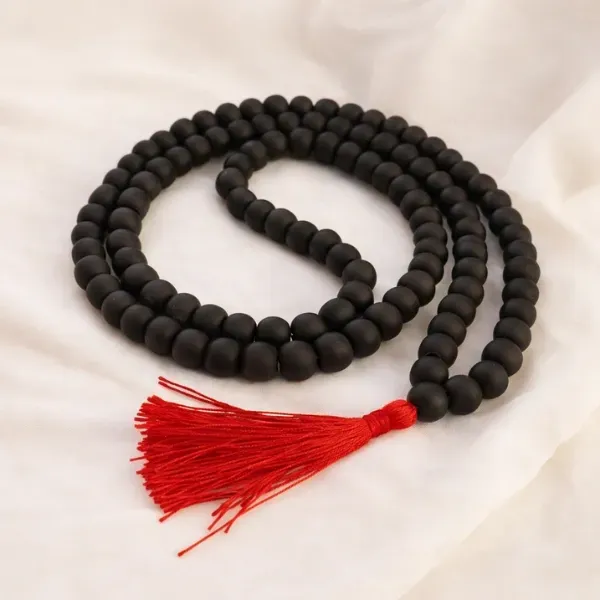
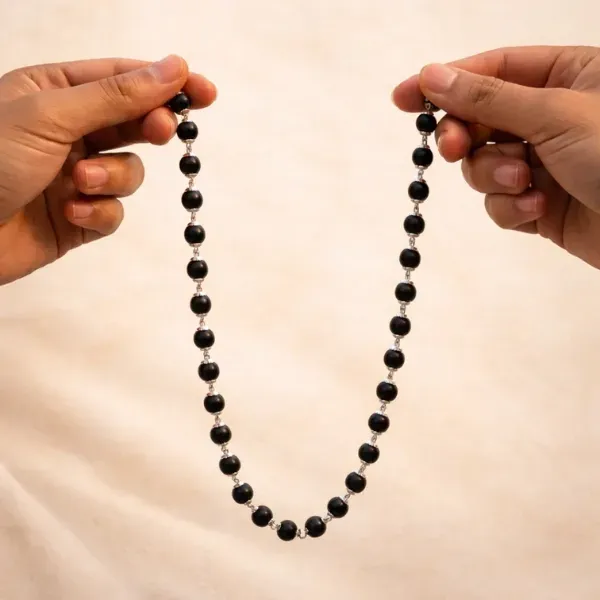
If you have spent any time in South Indian temples — particularly those dedicated to Lord Murugan or Lord Shiva — you have seen it. Dark, almost black beads around the neck of priests, sadhus, temple workers. Not Rudraksha. Not Tulsi. Something darker, denser, quieter.
Karungali.
Most people outside South India have never heard of it. Most people inside South India have seen it their whole lives but never been told exactly what it is, why it works, or what makes one piece genuine and another a waste of money.
This page exists to tell you all of it.
What Karungali Actually Is — The Tree, The Wood, The Bead
Karungali is the Tamil name for black ebony wood — from the tree Diospyros ebenum. The name itself is descriptive: "Karun" means black, "gali" refers to the hardwood. In botanical terms it belongs to the same family as persimmon trees, but Diospyros ebenum produces one of the densest, darkest, hardest natural materials found in any forest.
The tree grows slowly. Extremely slowly. A Karungali tree that produces wood suitable for spiritual use may be decades old. This slow growth is what gives the wood its density — and its density is what gives it its properties. Real Karungali sinks immediately in water. No other common wood does this the same way. It is simply that dense.
The wood is found primarily in South India — particularly Tamil Nadu and Sri Lanka — and historically in parts of Southeast Asia. It is not a commercially farmed material. Genuine Karungali comes from naturally grown trees, which is why authentic pieces have always been relatively rare and why the fake market exists at all.
The beads are cut from the heartwood — the deepest, densest core of the tree, where the wood is darkest and the spiritual concentration is considered highest. Heartwood-cut Karungali beads are noticeably heavier than most wooden beads. When you hold a genuine mala, the first thing you notice is the weight. This is not a light, decorative wooden necklace. It feels serious in your hand.
The Sacred Connection — Lord Murugan, Lord Shiva and Why This Wood Specifically
Karungali has always been most closely associated with two deities — Lord Murugan and Lord Shiva.
Lord Murugan — Skanda, Karthikeya, the son of Shiva — is the primary deity of Tamil devotion. He is the deity of courage, strength, clarity and the defeat of darkness. His weapon is the Vel — the divine spear that pierces illusion and destroys evil. The Karungali tree is considered sacred to Murugan in Tamil tradition — the dark, dense, immovable nature of the wood mirrors his qualities. In South Indian temples, Karungali wood is often used in the construction of sacred implements and ritual objects used in Murugan worship.
In Shaivite tradition, Karungali is considered especially sacred to Lord Shiva — connecting it to the broader Shaivite understanding of the universe's cycles of creation and dissolution. Saints and sadhus in the Shaivite tradition have worn Karungali alongside Rudraksha for centuries, often treating the two as complementary rather than alternatives.
What both deities share — courage, protection, the destruction of negative forces — is exactly what Karungali wood is understood to provide.
Why It Works — The Dense Wood That Absorbs What You Cannot See
Ancient traditions across India developed an understanding of materials and their properties that modern science is only beginning to examine. Ebony — Karungali — was consistently identified as a material with unusually powerful absorptive and protective properties.
The understanding in traditional practice is straightforward: Karungali wood absorbs negative energy. Not metaphorically — practitioners describe it as a material that actively draws in and holds negative vibrations from the wearer's environment, preventing those vibrations from affecting the wearer. Like a filter.
This is consistent with what material science knows about very dense, high-mineral-content wood. Dense materials interact differently with electromagnetic fields than lighter, more porous ones. Karungali's mineral composition — particularly its high iron content, which contributes to its density and dark colour — gives it properties that lighter woods simply do not have.
In Vedic astrology, Karungali is specifically connected to Mars (Mangal / Angaraka). Mars governs energy, courage, physical strength, blood and the ability to take decisive action. When Mars is malefic — as it is for those with Mangal Dosha or Sevvai Dosham — it creates specific problems: accidents, conflict, delayed marriage, financial disruption, excessive anger. Karungali is one of the primary Jyotish remedies for malefic Mars. Astrologers across Tamil Nadu, Kerala and Karnataka recommend it specifically for those with Sevvai Dosham and Mangal Dosha — alongside or as an alternative to red coral.
The wood also strongly activates the Muladhara — the Root Chakra. The Root Chakra governs safety, stability, physical grounding and the fundamental sense of being protected in the world. When it is out of balance — anxiety, restlessness, a constant underlying fear that something could go wrong — Karungali's dense, grounding energy addresses exactly that. Not by calming the mind directly, but by stabilising the physical and energetic foundation beneath it.
The Long History — Temples, Saints and Celebrities
Karungali's use in South Indian spiritual practice is not recent and not trend-driven.
In classical Tamil literature — the Sangam poetry, some of it over 2,000 years old — ebony wood appears as a material of significance and value. In temple architecture, Karungali was historically used in sacred spaces because it was understood to hold and radiate divine energy rather than simply occupying space. Some ancient temples in Tamil Nadu and Sri Lanka have Karungali wood structural elements that have survived centuries without deterioration — the wood's density makes it naturally resistant to insects, moisture and decay.
Saints and Siddhas in the South Indian tradition — the 18 Siddhas of Tamil tradition in particular — used Karungali in their practice. The Siddhas were not simply spiritual teachers. They were also profound healers, Ayurvedic practitioners, and scientists in the original sense of the word — systematic observers of nature. Their incorporation of Karungali into daily practice and healing was not superstition. It was observed and documented over generations.
In modern times — Rajinikanth, one of the most recognised figures in Tamil cinema and a devoted spiritual practitioner, has been photographed wearing Karungali malas regularly. Pawan Kalyan, known for his deep spiritual practice, has also been seen with Karungali. These are not fashion choices. These are men who take their spiritual practice seriously and choose their tools accordingly.
How to Know If Your Karungali Is Real
The fake market for Karungali is significant. Dyed wood, plastic beads, other dark woods sold as Karungali — all of these exist at every price point.
Genuine Karungali has very specific properties. It sinks immediately in water — this is one of the few reliable tests for this material. The wood is simply that dense. A bead that floats or sinks slowly is almost certainly not genuine Karungali heartwood.
The colour is naturally very dark brown to black — not uniformly black the way a painted or dyed piece would be. Real Karungali has slight natural variation in shade, with the grain of the wood sometimes visible as a slightly lighter pattern within the dark surface. It does not bleed colour into your skin or clothes. If a bead stains your skin — it has been dyed.
Real Karungali will not colour water significantly when soaked. Some very light tannin release is natural — it is wood. But if the water turns significantly dark — the bead has been treated or dyed.
The weight is always notable. If a dark wooden bead feels light — it is not Karungali. The density is non-negotiable. Pick up the mala. If it feels like a regular wooden necklace — it is probably a regular wooden necklace.
The smell is subtle and natural — a faint woody, earthy smell. Treated or dyed wood often carries a chemical or neutral odour. Genuine Karungali smells like what it is — an ancient, dense forest wood that has been there for decades.
How to Care for Karungali — So It Stays With You
Karungali wood is extremely durable by nature — but it responds to care and degrades with neglect.
Do not soak in water. Brief contact with plain water is fine — rain, accidental splashing. Extended soaking or washing with soap will dry out the wood over time, causing it to crack or lose its surface integrity.
Apply a drop of sesame oil or coconut oil occasionally — once a month, rubbed in gently with a soft cloth. This nourishes the wood, maintains its depth of colour and prevents drying. You will notice the wood comes alive slightly after oiling — the dark colour deepens, the surface develops a quiet lustre.
Keep away from perfume and chemical products. Karungali absorbs — that is its quality, and also its vulnerability. You do not want it absorbing synthetic chemicals instead of negative energy. Apply perfume first, wear the mala after.
Store in a clean cloth pouch when not wearing. Keep away from other metal jewellery — not because of damage to the wood, but because metals can affect the wood's energy over time in ways that are subtle but consistent.
Do not share your Karungali mala with others. Over time, a Karungali mala adapts to the energy of its wearer. This is not mystical — it is practical. A protective tool that has been working in one person's energy field is not the same object as one worn by a different person with a different energy field.
To cleanse and re-energise — on a Monday or a full moon night, place the mala near your deity or home mandir. Light a ghee lamp, chant "Om Namah Shivaya" or "Om Saravana Bhava" (Lord Murugan's mantra) 108 times. This is enough. No elaborate ritual required. Once every few months is sufficient.
Not sure which Karungali product is right for your situation or your birth chart? Use Suyagya's Astro AI — enter your birth details and get a personalised recommendation based on your planetary positions.