Having an Anxiety Attack? Here's Exactly What to Do (Step-by-Step Guide)
If you're in the middle of one right now: Stop. Take a slow breath in for 4 counts, out for 4 counts. You are not in danger. Your body is just confused — and honestly, a little overdramatic. Keep reading — this guide will walk you through exactly what to do, step by step.
Anxiety attacks are terrifying in the moment. Your heart races, your chest tightens, your brain screams "something is wrong." But here's the thing — nothing is medically wrong. Your nervous system has just hit a false alarm. And like every alarm, it stops. Always.
What Is an Anxiety Attack, Really?
An anxiety attack is a sudden surge of intense fear or discomfort that peaks within minutes. Most panic attacks reach their peak intensity within 10 minutes and rarely last longer than 20–30 minutes total.
Globally, anxiety disorders affect around 301 million people, making them the most common mental health condition in the world according to the World Health Organization. In the US alone, over 40 million adults live with anxiety disorders. So if this has happened to you, you are very much not alone — not even a little bit.
How Do You Know It's an Anxiety Attack and Not Something Else?
This matters — because anxiety attacks can physically feel like a heart attack, and that fear alone makes everything significantly worse.
Common anxiety attack symptoms include a racing heart, shortness of breath, chest tightness, dizziness, tingling in the hands or feet, sweating, and a strong sense that something terrible is about to happen. These are caused by adrenaline flooding your system — your body preparing to fight or run from a threat that isn't actually there.
A heart attack usually involves crushing chest pain that radiates to the arm or jaw, and it doesn't ease up on its own. If you're genuinely unsure, call emergency services. Always better to be sure.
Step-by-Step: What to Do the Moment an Anxiety Attack Hits
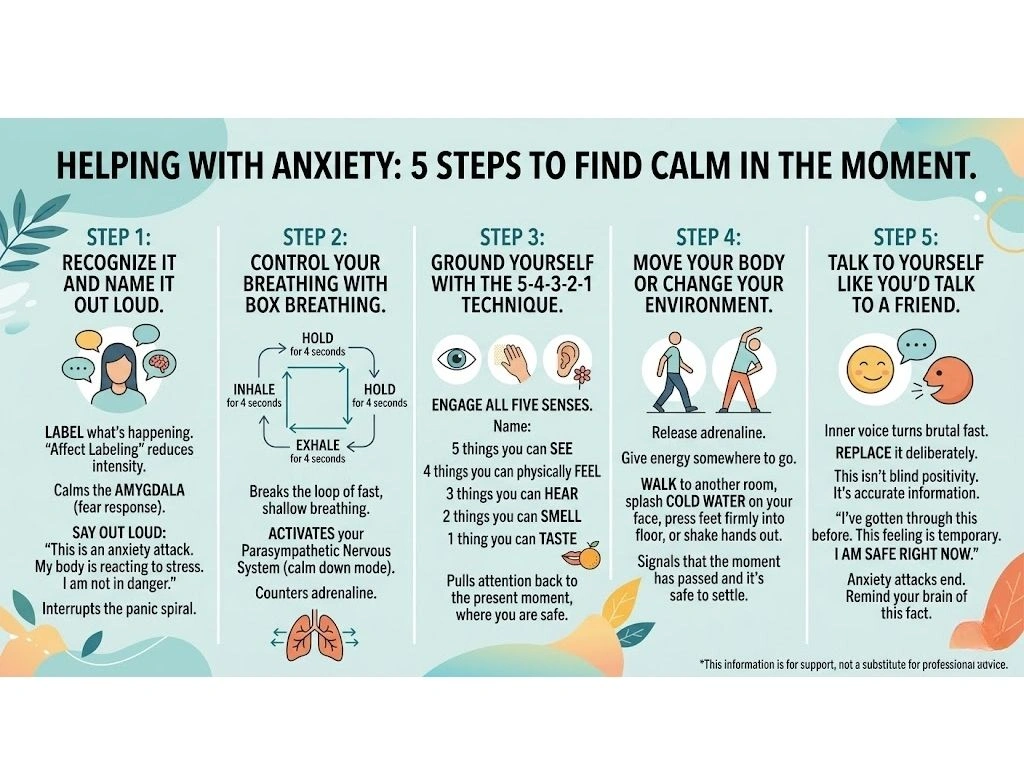
Step 1: Recognize It and Name It Out Loud
The first and most powerful thing you can do is label what's happening. Naming an emotion — something psychologists call "affect labeling" — genuinely reduces its intensity. It works by calming the amygdala, the part of your brain responsible for fear responses.
So say it out loud, even if it feels strange: "This is an anxiety attack. My body is reacting to stress. I am not in danger."
This one sentence can interrupt the panic spiral. Your brain is scanning for a threat — giving it a clear answer helps it stand down.
Step 2: Control Your Breathing With Box Breathing
When anxiety hits, your breathing becomes fast and shallow — which actually makes things worse. It lowers your carbon dioxide levels, causing dizziness and a faster heart rate, which your brain then reads as more danger. It becomes a loop.
Box breathing breaks that loop. Inhale for 4 seconds. Hold for 4 seconds. Exhale for 4 seconds. Hold for 4 seconds. Repeat four times.
This technique directly activates your parasympathetic nervous system — your body's natural "calm down" mode — and counters the adrenaline surge. It's simple, free, and works anywhere.
Step 3: Ground Yourself With the 5-4-3-2-1 Technique
When your mind is spiraling, it needs something real to hold onto. This technique pulls your attention back into the present moment by engaging all five senses.
Name 5 things you can see. Name 4 things you can physically feel — the floor under your feet, the temperature of the air, your clothes on your skin. Name 3 things you can hear. Name 2 things you can smell. Name 1 thing you can taste.
Anxiety lives in the future — it feeds on "what if." Grounding pulls you back to right now, where you are actually safe.
Step 4: Move Your Body or Change Your Environment
Your body has released adrenaline to prepare you to fight or run. If you just sit still with it, that energy has nowhere to go — and the anxious feeling lingers longer than it needs to.
Do something physical. Walk to another room. Splash cold water on your face. Press your feet firmly into the floor and feel that contact. Even standing up and shaking your hands out can help. You're giving your nervous system a clear signal that the moment has passed and it's safe to settle.
Step 5: Talk to Yourself Like You'd Talk to a Friend
This is the step most people skip — and it might be the most important one.
During an anxiety attack, the inner voice turns brutal fast. "Why is this happening again? Something must really be wrong with me." That voice makes it worse — not because you're weak, but because your brain is listening and taking notes.
Replace it deliberately: "I've gotten through this before. This feeling is temporary. I am safe right now."
This isn't blind positivity. It's accurate information. Anxiety attacks end. Every single one of them. Reminding your brain of that fact is one of the most effective things you can do in the moment.
What Should You NOT Do During an Anxiety Attack?
A few common instincts that actually backfire — and most of us have tried at least one of these:
Don't Google your symptoms mid-attack. Searching "chest tightness and shortness of breath" will almost certainly surface results about heart attacks and emergencies. That will spike your anxiety significantly, not help it.
Don't try to fight or resist the feeling. Anxiety is like a rip current — fighting it exhausts you faster. Accepting that it's happening and working through the steps above is far more effective than trying to force the feeling away.
Don't use alcohol to calm down. It might feel like relief in the moment, but alcohol disrupts the brain's calming systems over time, making anxiety worse in the long run — not better.
How Long Does an Anxiety Attack Last?
Most anxiety attacks peak within 10 minutes. The full episode — including the wind-down — typically lasts between 20 and 30 minutes. It genuinely feels like longer when you're inside it, but it isn't.
After the attack, it's completely normal to feel exhausted, shaky, and emotionally drained. Your body just ran a physiological marathon without leaving the room. Rest, drink water, and be gentle with yourself for the rest of that hour.
Can You Reduce or Prevent Anxiety Attacks Over Time?
Yes — and this is genuinely good news. Anxiety attacks are not a life sentence.
Cognitive Behavioural Therapy (CBT) is the most well-researched treatment for anxiety disorders and panic. Studies consistently show that a large majority of people with panic disorder see significant improvement with CBT, often within just a few months of sessions.
Regular exercise, reducing caffeine, consistent sleep, and mindfulness practice all play real roles in reducing how often attacks happen. Even something as simple as keeping a short journal — noting when attacks occur, what you were doing, how you were feeling — can help you start identifying your personal triggers over time.
When Should You See a Doctor?
If anxiety attacks are happening frequently, are interfering with your daily life, or you're avoiding situations because you're afraid of triggering one — please reach out to a professional. This is not weakness. This is the same logic as seeing a doctor for any physical condition that keeps coming back.
Your nervous system is stuck in a pattern it needs help getting out of. A therapist or doctor can help you do that — often faster than you'd expect.
Helplines: In India — iCall (TISS): 9152987821 In the UK — NHS Talking Therapies (free, self-refer) In the US — SAMHSA helpline: 1-800-662-4357
More of a Spiritual Person? Here's What Citrine Has to Do With Anxiety
Not everyone connects with crystals — and that's completely fine. But if you're someone who finds comfort in spiritual tools alongside the practical steps above, citrine is one worth understanding properly. Not the "it will cure everything" version. The honest one.

What Exactly Is Citrine and Where Does It Come From?
Citrine is a yellow variety of quartz. Its colour comes from iron within the crystal — nothing mystical about the geology. But humans have carried it, carved it, and worn it intentionally for thousands of years. Ancient Greeks, Romans, Egyptians — they all had a relationship with it. That doesn't make it magical, but it does make it meaningful in a way that's hard to dismiss entirely.
What Do Spiritual and Chakra Traditions Say About Citrine?
In crystal healing and chakra traditions, citrine is linked to the solar plexus — the energy centre connected to personal power, confidence, and emotional steadiness. Anxiety, in this framework, is often seen as a block in exactly that space.
In Vedic astrology, citrine is associated with Jupiter — the planet of wisdom, calm, and expansion. It's considered one of the more gentle, uplifting stones. No drama, no intensity — just warmth and clarity.
People who use it aren't usually making grand claims. Most simply say it helps them feel a little more centred. And honestly? That's worth something.
What Does Psychology Actually Say About Using Citrine?
There's no clinical proof that citrine changes your brain chemistry. Worth saying that clearly.
But psychology does explain why it might still help — and it's more interesting than just "placebo."
When you hold something intentionally during an anxious moment — whether it's a stone, prayer beads, or even a specific pen — your brain starts associating that object with the feeling of calm you practiced alongside it. Over time, just touching it can begin to trigger that state. That's not magic. That's how the brain builds associations.
The act of reaching for it, pausing, feeling its texture in your hand — that's already a grounding moment. You're engaging your sense of touch, slowing down, coming back to the present. Sound familiar? It's essentially the same logic as the 5-4-3-2-1 technique from earlier in this article.
Colour psychology adds a quiet piece too — yellow is consistently linked with warmth and optimism. A gentle, real effect. Nothing dramatic, but not nothing either.
How Do People Actually Use Citrine for Anxiety Day to Day?
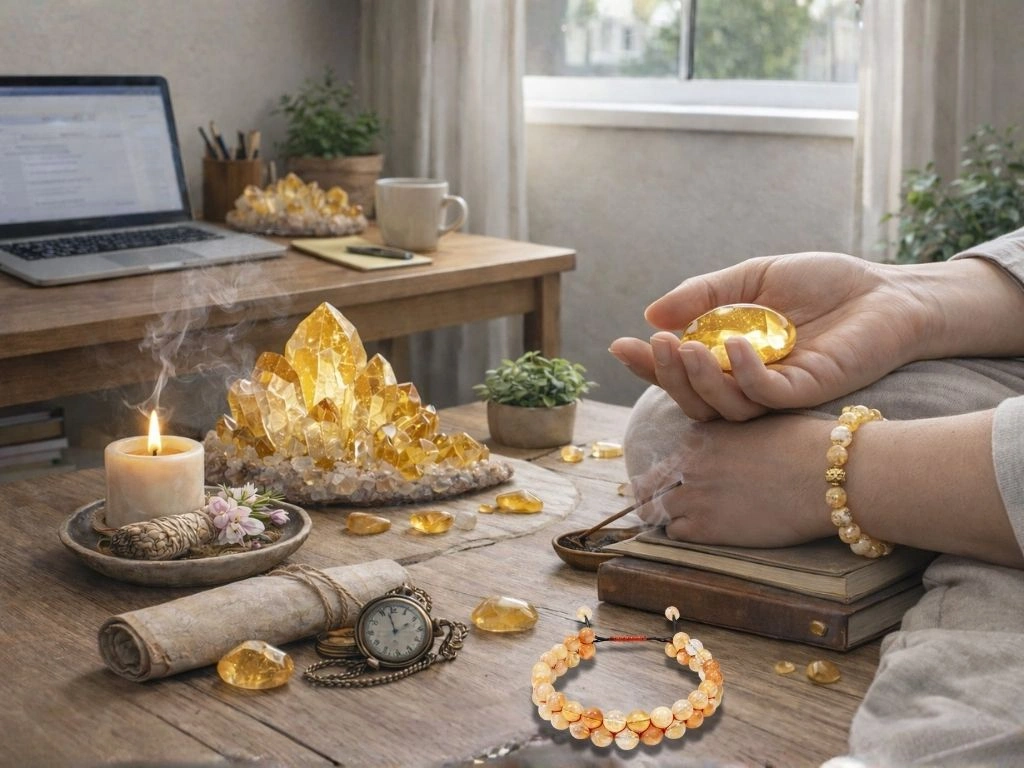
Most people who use citrine for anxiety aren't replacing therapy or medication. They're adding one small, intentional ritual to their day — holding it during meditation, keeping it on their desk during stressful work hours, or reaching for it when a wave of panic begins.
The pause that comes with that reach — that tiny moment of "okay, breathe" — is the real thing doing the work. The citrine just gives that moment somewhere to live.
So Does Citrine Actually Help — or Is It Just a Pretty Stone?
Honestly? Both, depending on how you use it.
It won't cure anxiety. Nothing you hold in your hand will do that alone — and anyone who tells you otherwise is selling something. But if you're someone who finds meaning in ritual and symbolism, there's nothing irrational about using a warm yellow stone as an anchor for your calm. The intention you bring to it is real. The grounding practice you build around it is real. The stone just makes it easier to remember to come back to yourself.
Sometimes a small, beautiful reminder is exactly what you need in a hard moment. And that's not nothing — that's actually quite a lot.
You made it to the end of this article — which means either you're doing research, or the worst has already passed and you're okay. Either way, good. You handled it. And you'll handle it again, with a little more ease each time.
Can You Wear Citrine Instead of Just Holding It?
Yes — and many people find it even more effective that way.
Wearing citrine as a pendant, bracelet, or ring means it stays close to your body throughout the day without you having to think about it. You're not just using it in meditation — it becomes a quiet, constant reminder of the intention you've set for yourself.
There's a practical reason this works too. Skin contact with an object you've consciously associated with calm creates more frequent reinforcement of that mental anchor. Every time you notice it — glancing at your wrist, feeling it at your collarbone — it's a tiny nudge back to your breath, your body, the present moment.
In chakra traditions, wearing citrine near the solar plexus — so as a pendant around mid-chest — is specifically recommended because that's the energy centre it's believed to activate. Whether you follow that framework or not, keeping it physically close simply gives you more touchpoints in your day.
A ring works well for anxious hands. A bracelet is easy to reach for and hold during stressful moments. A pendant sits quietly and does its job without asking for anything.
It doesn't need to be expensive or elaborate. A small, real citrine piece worn with intention will do more than a large one worn without thought.