10 Simple Ways to Relax Your Mind — Backed by Science and Ancient Practice
Some days the mind just won't stop. You're not doing anything particularly stressful — you're just sitting there, and somehow your brain is running a hundred conversations, replaying yesterday, planning tomorrow, and worrying about three things that haven't even happened yet. Sound familiar?
The good news is that calming the mind doesn't require an hour of meditation or a weekend retreat. It requires the right technique at the right moment — and most of them take under ten minutes. Here are ten that actually work, drawn from both science and traditions that have been refining this for thousands of years.
Why Does the Mind Get So Noisy in the First Place?

Before the techniques — a quick explanation, because understanding what's happening makes everything work better.
When your mind is restless, your brain's default mode network is overactive. This is the neural system responsible for self-referential thinking — the inner voice that replays conversations, imagines future scenarios, and generates the endless mental commentary that makes silence feel impossible. It activates automatically whenever you're not focused on a specific external task. Left unchecked, it creates the feeling of a mind that never truly rests.
At the same time, a restless mind keeps your nervous system slightly elevated — cortisol and adrenaline stay higher than they should, your breathing stays shallow, and your body never fully reaches the rest state it needs. The mind and body are in a feedback loop: a noisy mind creates physical tension, and physical tension keeps the mind noisy. The fastest way to break this loop is to intervene at the body level first — because the body is easier to change quickly than the mind.
10 Ways to Calm Your Mind in 10 Minutes or Less
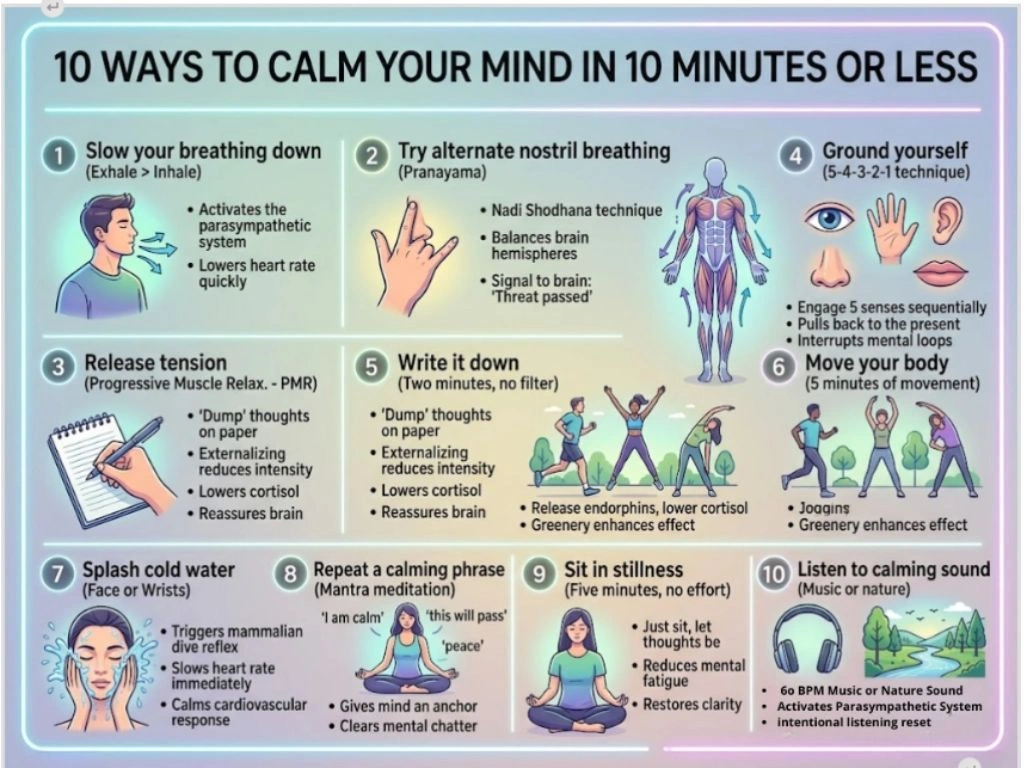
1. Slow your breathing down — specifically the exhale
Breathing is the fastest direct route to your nervous system — and the exhale is the part that actually triggers the calm response. When you exhale for longer than you inhale, you activate the parasympathetic nervous system — your body's built-in rest mode. This directly lowers heart rate and blood pressure within minutes.
Try the 4-7-8 method: inhale for four counts, hold for seven, exhale for eight. Or simply breathe in for four counts and out for six — the ratio matters more than the specific numbers. Do this for two to three minutes and notice what happens. Psychologist Judith Tutin, Ph.D. describes deep breathing as "the number one most effective technique for reducing anxiety and anger quickly" — and the research consistently backs that up.
2. Try alternate nostril breathing
This one comes from pranayama — the ancient Indian science of breath — and it works on a specific neurological principle. Closing the right nostril and breathing through the left activates the parasympathetic system. Closing the left and breathing through the right activates alertness. Alternating between them, as done in Nadi Shodhana pranayama, literally balances both hemispheres of the brain.
Emily Fletcher, founder of Ziva Meditation, describes it as having "immediate energizing and calming effects simultaneously." It sounds unusual until you try it — most people feel noticeably clearer and calmer within three to five minutes. Sit comfortably, close your right nostril with your thumb, inhale through the left, then switch and exhale through the right. Repeat for five cycles.
3. Release the tension your body is holding
Stress doesn't just live in the mind — it accumulates in the body as muscle tension, often in places you stop noticing: the jaw, the shoulders, the hands, the stomach. Progressive muscle relaxation (PMR) is a clinically proven technique that directly addresses this. Tense one muscle group for five seconds, then release completely and notice the difference for ten seconds. Move from your feet upward through your whole body.
It sounds simple because it is. But the reason it works is that releasing physical tension sends a direct signal to your brain that the threat has passed — which quiets the mental noise that tension was feeding. The Mayo Clinic recommends PMR specifically for breaking the stress-tension cycle, and research confirms it reduces both physical and psychological stress markers within a single session.
4. Use the 5-4-3-2-1 grounding technique
A restless mind lives in the future — replaying worries, projecting outcomes, running worst-case scenarios. Grounding pulls it back to the present, where right now, you are actually fine. The 5-4-3-2-1 technique does this by forcing your brain to engage all five senses sequentially: name five things you can see, four you can feel, three you can hear, two you can smell, one you can taste.
This works because it gives the overactive default mode network something real and external to process — which interrupts the internal loop. It takes about three minutes and can be done anywhere, in any situation, without anyone around you knowing what you're doing. It's particularly effective during moments of sudden overwhelm or anxiety.
5. Write down what's in your head — two minutes, no filter
One of the most consistently underrated calming techniques is the simplest: get what's in your head onto paper. Not to solve it, not to organise it — just to move it from inside you to in front of you. That act of externalising creates enough psychological distance to reduce the emotional intensity of whatever is spinning around in there.
Set a two-minute timer and write without editing, without rereading, without judging. Just empty the queue. Research consistently shows this lowers cortisol and reduces the feeling of mental overload. The brain has a tendency to keep cycling through unresolved thoughts to make sure you don't forget them — writing them down reassures it that they've been captured, and it lets them go.
6. Move your body for five minutes
Physical movement is one of the fastest ways to break a mental loop — because it gives your nervous system something real to do with the stress energy that's built up. Just five minutes of aerobic movement — a brisk walk, some jumping jacks, even shaking your hands out and rolling your shoulders — begins to release endorphins and lower cortisol. WebMD research confirms that as little as five minutes of exercise starts to calm the mind measurably.
If you can step outside while doing it, even better. Research shows that looking at natural greenery — trees, plants, sky — reduces stress and improves mood within minutes independently of the movement. The combination of both is particularly powerful. Your body was built to move when stressed. Giving it permission to do so is one of the fastest resets available.
7. Splash cold water on your face or wrists
This one takes about thirty seconds and works through a specific physiological mechanism. Cold water on the face activates the mammalian dive reflex — a hardwired response that automatically slows your heart rate and redirects blood flow to your vital organs. It is physically very difficult for your nervous system to stay in a high-alert state when this reflex triggers.
Running cold water over your wrists has a similar effect — the major arteries that run through the wrists are close to the surface, and cooling them quickly lowers overall body temperature and calms the cardiovascular stress response. The American Institute of Stress specifically recommends this for immediate calm. It's not glamorous, but it works faster than almost anything else.
8. Repeat a calming word or phrase
This is one of the oldest and most effective forms of meditation — and it works for a straightforward reason. The mind cannot hold two thoughts at once. When you give it a single word or phrase to return to — "I am calm," "this will pass," "I am here," or simply "peace" — it has something to hold onto instead of the noise. Every time the mind wanders, you return to the word. That return is the practice.
Mayo Clinic identifies mantra meditation as one of the most effective forms of meditation for clearing mental chatter and reducing stress — precisely because it gives the restless mind a specific anchor rather than asking it to simply be empty. You don't need a Sanskrit mantra or a teacher. A word that genuinely resonates with you is enough to begin.
9. Sit in deliberate stillness for five minutes
Not meditation in the formal sense — just stillness. Sit somewhere quiet, close your eyes, and do nothing for five minutes. Don't try to clear your mind. Don't try to relax. Just sit and let whatever is there, be there. Watch the thoughts without following them. Notice the sounds without labelling them. This practice — sometimes called open awareness — works by taking the pressure off. Most mental noise actually intensifies when you fight it. Allowing it without engaging it tends to quiet it on its own.
Research from Harvard on the default mode network shows that giving the brain genuine downtime — not screen time, not input, but actual stillness — reduces mental fatigue and restores cognitive clarity more effectively than distraction does. Five minutes of real stillness is worth more than thirty minutes of passive scrolling.
10. Listen to something calming — music, nature sounds, or silence
Sound has a direct effect on the nervous system. Calm, slow music at around 60 beats per minute has been shown to lower blood pressure and reduce cortisol. Nature sounds — rain, flowing water, birdsong — activate the parasympathetic nervous system and reduce the brain's threat-detection response. Even silence, after a period of noise, produces measurable physiological calm.
Create a short playlist of genuinely calming tracks — not background music you half-listen to, but something you sit with intentionally for five to ten minutes. The difference between passive and intentional listening is significant. Done with full attention, even a single piece of music can produce a complete nervous system reset.
Building It Into Your Day — What Consistency Actually Looks Like
Any one of these techniques can help in the moment. But the real shift happens when you stop treating calm as something you reach for in a crisis and start treating it as something you maintain through small daily practices.
The most effective daily framework is simple:
- Morning — 5 minutes: Before picking up your phone, sit quietly, breathe slowly, and set one clear intention for the day.
- Midday — 2 minutes: A quick body scan or breathing reset between tasks. This prevents tension from building up to the point where it becomes overwhelming.
- Evening — 5 minutes: Write down what's on your mind, release the day, and prepare your nervous system for rest.
That's twelve minutes total. Not a dramatic overhaul — a small, consistent investment in the baseline state of your mind.
If You Want to Go Deeper — The Case for a Daily Meditation Practice
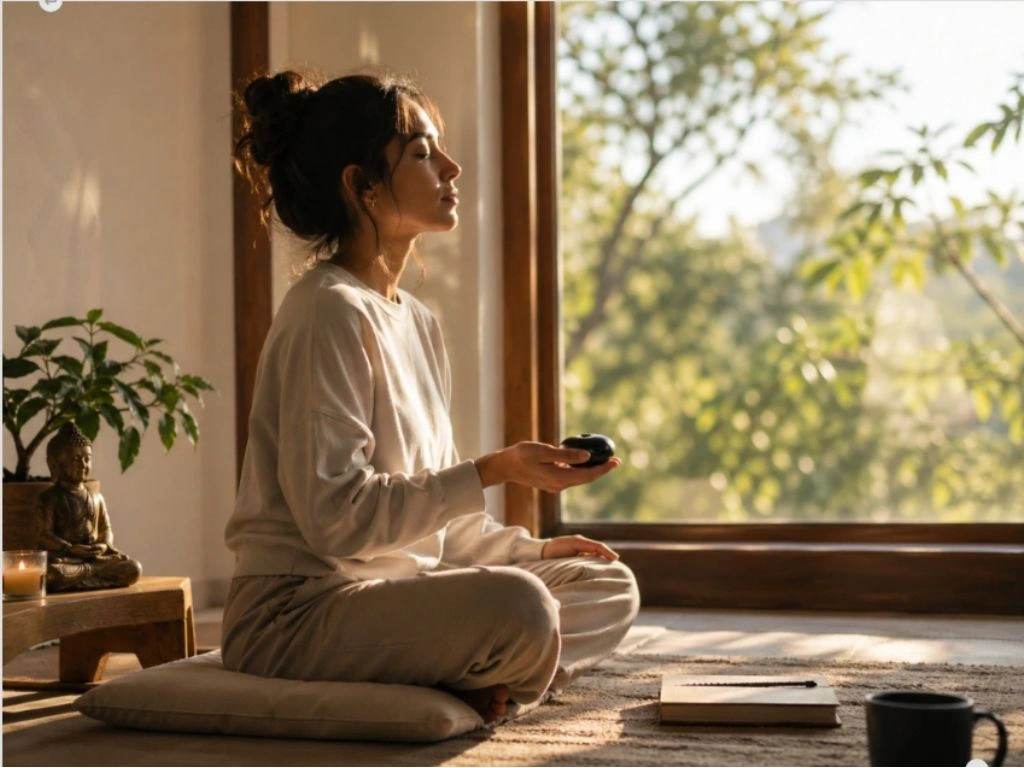
The techniques above are effective interventions. Meditation is something different — it's a practice that, over time, changes the baseline state of your mind so that it requires less intervention in the first place.
Regular meditation — even five to ten minutes a day — measurably reduces activity in the default mode network, strengthens the prefrontal cortex's ability to regulate emotion, and builds what researchers call "dispositional mindfulness" — a lasting, baseline quality of mental calm that doesn't require active effort to access. Mayo Clinic recognises meditation as clinically effective for reducing stress, anxiety, and even blood pressure over time.
The challenge for most beginners is that silent meditation feels uncomfortable — the mind wanders immediately, and that feels like failure. It isn't. The wandering is expected. The returning to the breath or the mantra is the actual practice. Every return builds the neural pathway that makes calm more accessible over time.
For people who find silent meditation difficult to maintain, having a physical anchor — something tactile to hold that keeps the mind grounded — makes a significant difference. This is one of the oldest insights in contemplative practice across traditions.
The Tulsi Mala — A Meditation Tool With Deep Roots

For those who want to build a consistent meditation or mantra practice, a Tulsi Mala is one of the most time-honoured tools in the Indian spiritual tradition — and its usefulness is practical, not just symbolic.
Tulsi — holy basil — holds a uniquely sacred place in Hindu tradition. It is associated with Lord Vishnu and is considered one of the most purifying and spiritually potent plants in Vedic knowledge. A Tulsi Mala made from the stems and beads of the Tulsi plant carries both a distinctive natural fragrance and an energetic quality that practitioners across generations have described as inherently calming and clarifying.
The 108 beads of a traditional Tulsi Mala are used to count mantra repetitions — one bead per repetition — giving the restless mind a specific, tactile task to follow. This is exactly what makes it effective for people who struggle with silent meditation: the hands are occupied, the mind has a sound to hold, and the bead-by-bead rhythm creates a natural, calming pace that the nervous system settles into over time.
Holding a Tulsi Mala during a simple mantra practice — even something as accessible as repeating "Om" or "Om Namah Shivaya" — combines the neurological benefits of mantra meditation with the grounding effect of the tactile rhythm and the subtle fragrance of the Tulsi beads themselves. Many people find that the scent of Tulsi alone has an immediate calming effect — which makes sense, as aromatherapy research consistently shows that natural plant fragrances interact directly with the nervous system.
It doesn't need to be a formal or elaborate ritual. Five minutes in the morning, mala in hand, a simple mantra repeated quietly — that's enough to begin building a practice that changes how the mind defaults to calm over time.
The Mind Responds to What You Give It
A noisy, restless mind is not a broken mind. It's a trained mind — trained by years of constant input, distraction, and the habit of never fully stopping. The good news is that what has been trained can be retrained. The mind responds to what you consistently give it.
Give it five minutes of slow breathing. Give it a word to return to. Give it stillness without a screen. Give it the rhythm of beads moving through your hands. Give it any of the ten techniques above, done consistently, and it will change — gradually, quietly, and more reliably than most people expect.
You don't have to do everything at once. Start with one. Do it today. That's enough to begin.