 Best Offers for You



Most crystal bracelets announce themselves.
Bright purple amethyst. Deep black hematite. Bold green malachite. You know what they are from across the room. That is part of their appeal — the colour is the statement.
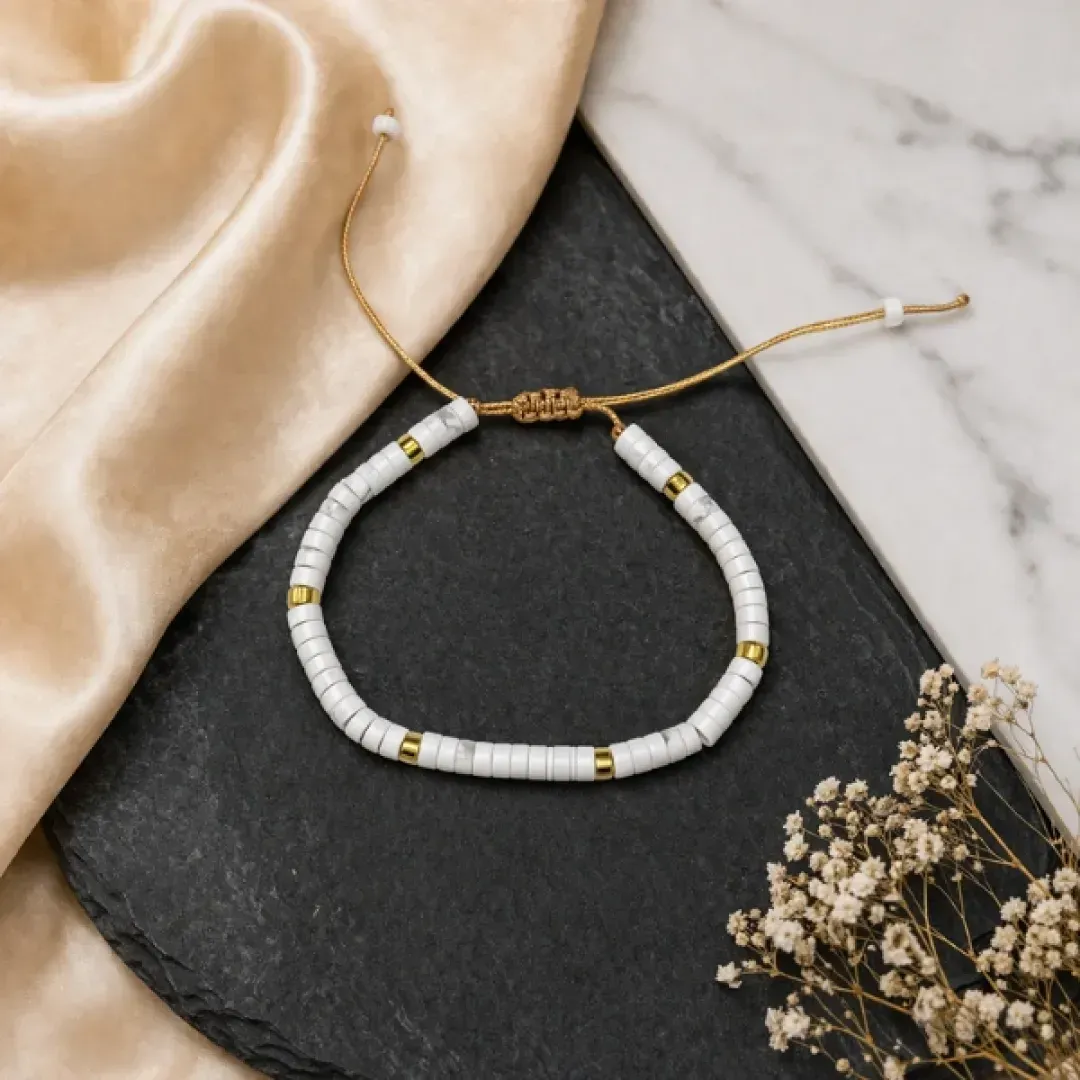
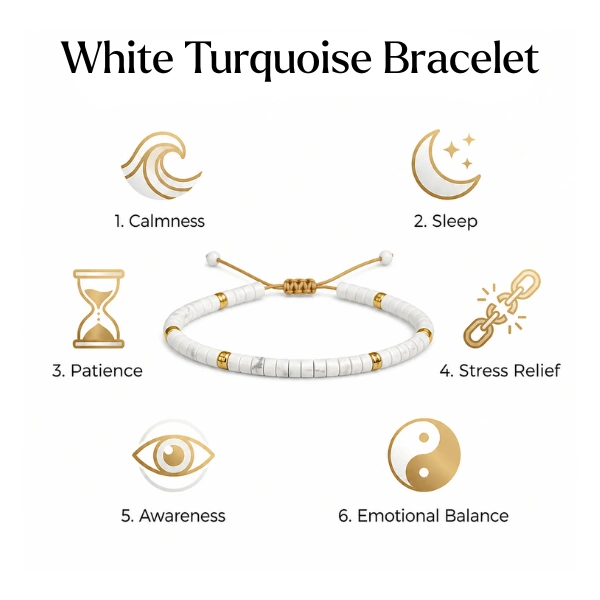
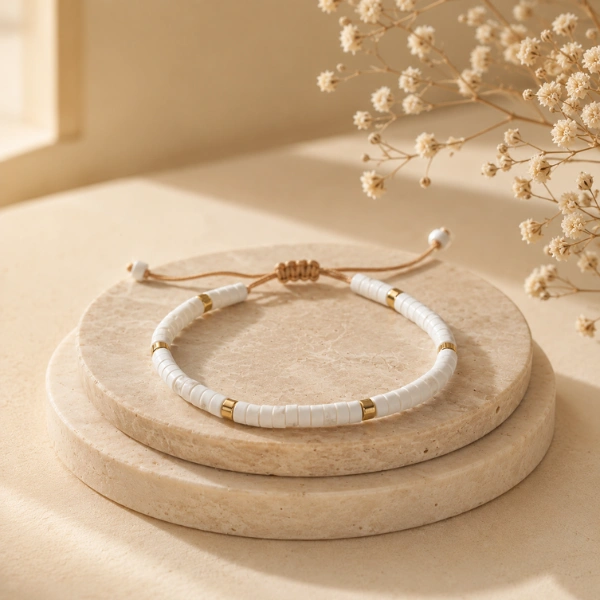
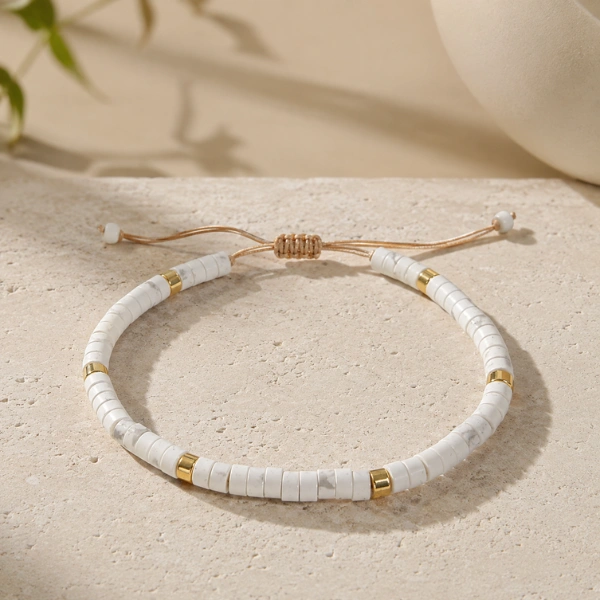
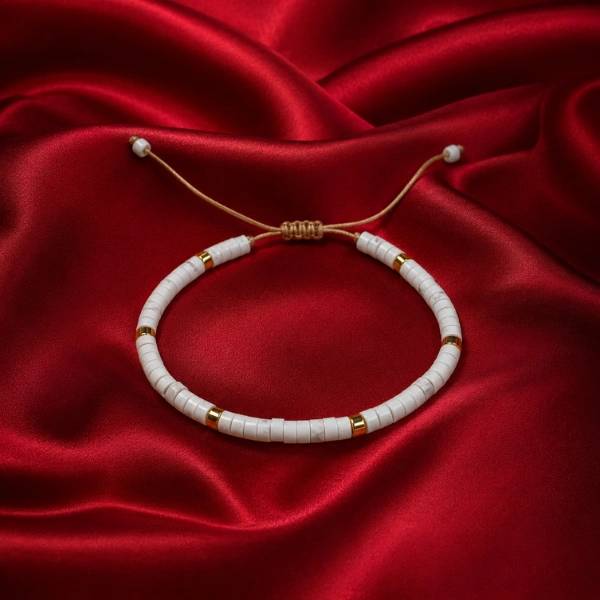
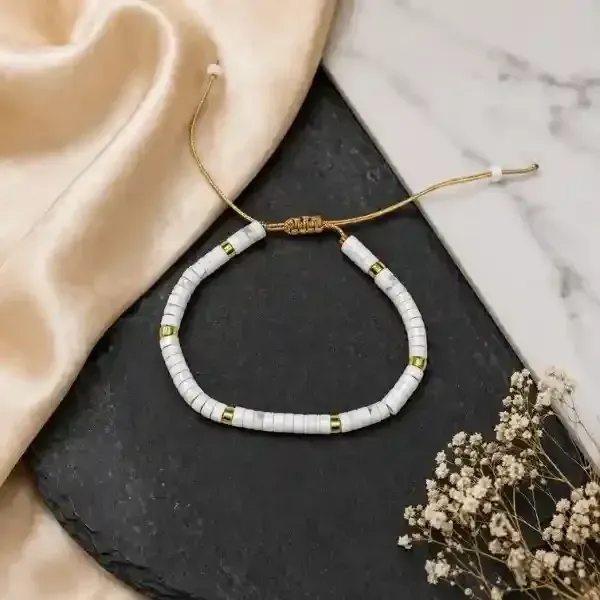
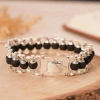
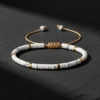
This bracelet does something different. It blends in. A row of small white disc beads on a tan cord with a few gold accents — from a distance, it reads as minimal jewellery. Clean. Restrained. The kind of thing you would see on someone with genuinely good taste and wonder where it came from.
And then you find out it is white turquoise. And that it is doing things you did not expect a bracelet this quiet to do.
White Turquoise — The Stone Most People Have Never Encountered
When people think of turquoise, they think blue. The vivid sky-blue or blue-green of the stone has made it one of the most recognisable gemstones in the world — worn by Egyptian pharaohs, Persian royalty, Native American healers, and contemporary jewellery designers alike.
White turquoise is different. It forms in the same mineral family — hydrated copper and aluminium phosphate — but in conditions where copper concentrations are lower, producing a stone that ranges from pure white to off-white to very pale grey, with the characteristic matrix of grey-brown veining that proves its natural origin.
The matrix — those fine grey-brown lines running through the white surface — is not a flaw. It is the stone's fingerprint. A record of where it formed and how. No two pieces have identical matrix patterns. The bracelet on your wrist is, in the most literal sense, one of a kind.
White turquoise is found primarily in Nevada and Arizona in the United States, with some deposits in China and Iran. It is rarer than blue turquoise — partly because the conditions that create it are less common, and partly because for most of turquoise's commercial history, white specimens were considered less desirable than blue and were not mined selectively. That perception has shifted. Collectors and jewellery designers who understand turquoise now seek white specimens specifically — for their rarity, their subtle beauty, and their specific energetic properties.
What Changes When Turquoise Is White
Blue turquoise and white turquoise share the same mineral family and many of the same healing associations — protection, communication, emotional balance, connection to the natural world. These qualities are consistent across all turquoise varieties.
But the colour change shifts the emphasis.
Blue turquoise works primarily with the Throat Chakra — Vishuddha — and the communication, expression and protection associated with it. It is an active, projecting stone. It gives you the courage to speak.
White turquoise adds a dimension that blue does not carry in the same way. White in crystal tradition is associated with the Crown Chakra — Sahasrara — and with qualities of mental clarity, purity of thought, and quiet inner strength. White turquoise is not louder or more powerful than blue turquoise. It is calmer. More inward. It helps you think clearly before you speak rather than giving you the courage to say anything.
The combination — Throat Chakra communication properties shared with all turquoise, plus the Crown Chakra clarity and stillness of the white variety — makes white turquoise specifically useful for people who overthink, who second-guess what they want to say, who have the words but cannot find the right moment or the right way to say them.
It is also one of the most consistently recommended stones in crystal tradition for anxiety and an overactive mind — alongside amethyst. The reasoning is similar: white stones tend to have a cooling, quieting energetic quality that slows down mental noise rather than adding to it.
Turquoise Through History — A Stone That Has Crossed Every Culture
No gemstone has been worn across more civilisations than turquoise. This is not coincidence. It is consistent cross-cultural recognition of something real.
Ancient Egypt — Turquoise was the first gemstone to be mined in human history, with records of Egyptian turquoise mining from the Sinai Peninsula going back 6,000 years. It was called "mefkat" — the stone of joy. It was found in the burial chamber of Tutankhamun. Cleopatra famously wore it. In Egyptian cosmology, turquoise was the colour of new growth, of the Nile's renewal — a stone of life.
Persia — Persian turquoise from the Nishapur mines in Khorasan was the most prized in the ancient world. Persian warriors wore it on their horses' bridles and their own armour — believing it protected them in battle and sharpened their judgment. The oldest known use of turquoise in India comes from Persian trade routes — it arrived here as a stone of power.
Native America — In Navajo, Zuni and Pueblo traditions, turquoise is not a gemstone. It is a sacred material. It represents the sky, the water, and the connection between earth and heaven. The disc bead form — flat, strung together — originates in Native American craftsmanship, developed by the Santo Domingo Pueblo people. A white turquoise disc bracelet is, in its form and its material, a convergence of two of the oldest jewellery traditions in human history.
Vedic India — In Indian astrological tradition, turquoise (Firoza) is associated with Jupiter (Guru) and with Venus (Shukra). Jupiter governs wisdom, expansion and spiritual growth. Venus governs beauty, love and harmony. Turquoise bridges both — it is recommended for those seeking clarity, calm and protected communication. White turquoise, with its Crown Chakra association, leans more toward Jupiter's clarity and less toward Venus's emotion — making it particularly suited for thinkers, writers, and those in demanding intellectual or communication-heavy work.
The Disc Cut — Why It Works For White Turquoise Specifically
White turquoise in a round bead bracelet looks fine. White turquoise in disc cut looks different — and for a specific reason.
The flat disc face shows more stone surface than a round bead of the same diameter. On white turquoise, this means more of the natural matrix pattern is visible — the grey-brown veining that gives each disc its individual character. A round bead shows you the colour. A disc shows you the character.
The discs stacked together also create a texture that reads as more sophisticated than round beads — the slight variations between individual discs, the way the matrix pattern shifts from one to the next, the subtle dimensional quality of flat discs seen edge-on. This is why white turquoise disc bracelets look more like fine jewellery and less like a crystal bracelet. The format suits the stone's quiet, considered quality.
Why This Bracelet Works for People Who Don't Usually Wear Crystal Bracelets
Most people who come to this bracelet are not primarily crystal enthusiasts. They are people who want something on their wrist that looks genuinely good, works with everything they own, and happens to also be doing something beneficial.
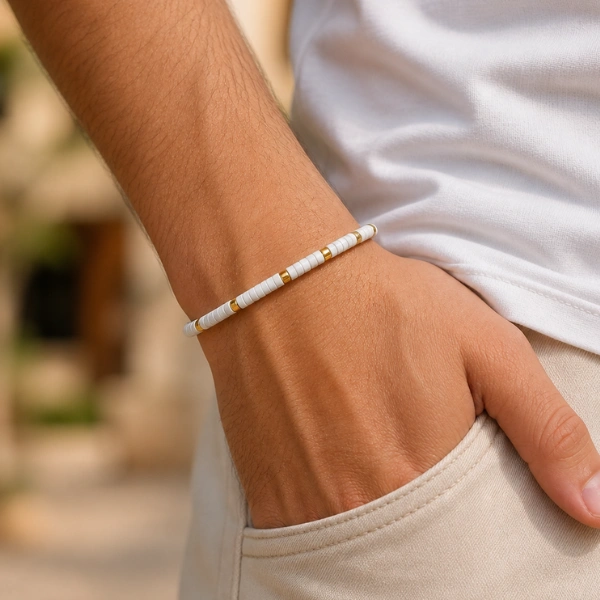
The white-and-gold colour combination — white stone, tan cord, gold accents — is one of the most versatile in jewellery. It works with white shirts. It works with kurtas. It works with formal wear. It works with casual denim. It does not clash with anything because it does not assert itself loudly. It sits quietly and looks considered.
That same quality in the stone — the quietness, the restraint, the inward focus — is exactly what makes it useful energetically. This is a bracelet for people who need calm more than they need excitement. Who need clarity more than they need courage. Who need the mental noise to settle rather than for something to amplify it.
Pair this with the Sea Sediment Jasper Bracelet for a complete contrast — colour and calm, all chakras and focused clarity, worn together or alternated by day.
Explore the complete Bracelet collection at Suyagya for more crystal options.
— Team Suyagya "Suyagya hai, toh asli hi hoga."