 Best Offers for You




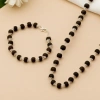
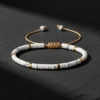

Most bracelets show you everything upfront.
The colour, the shimmer, the beauty — all visible the moment you pick them up. You know what you are getting. It is straightforward.
This bracelet is not like that.
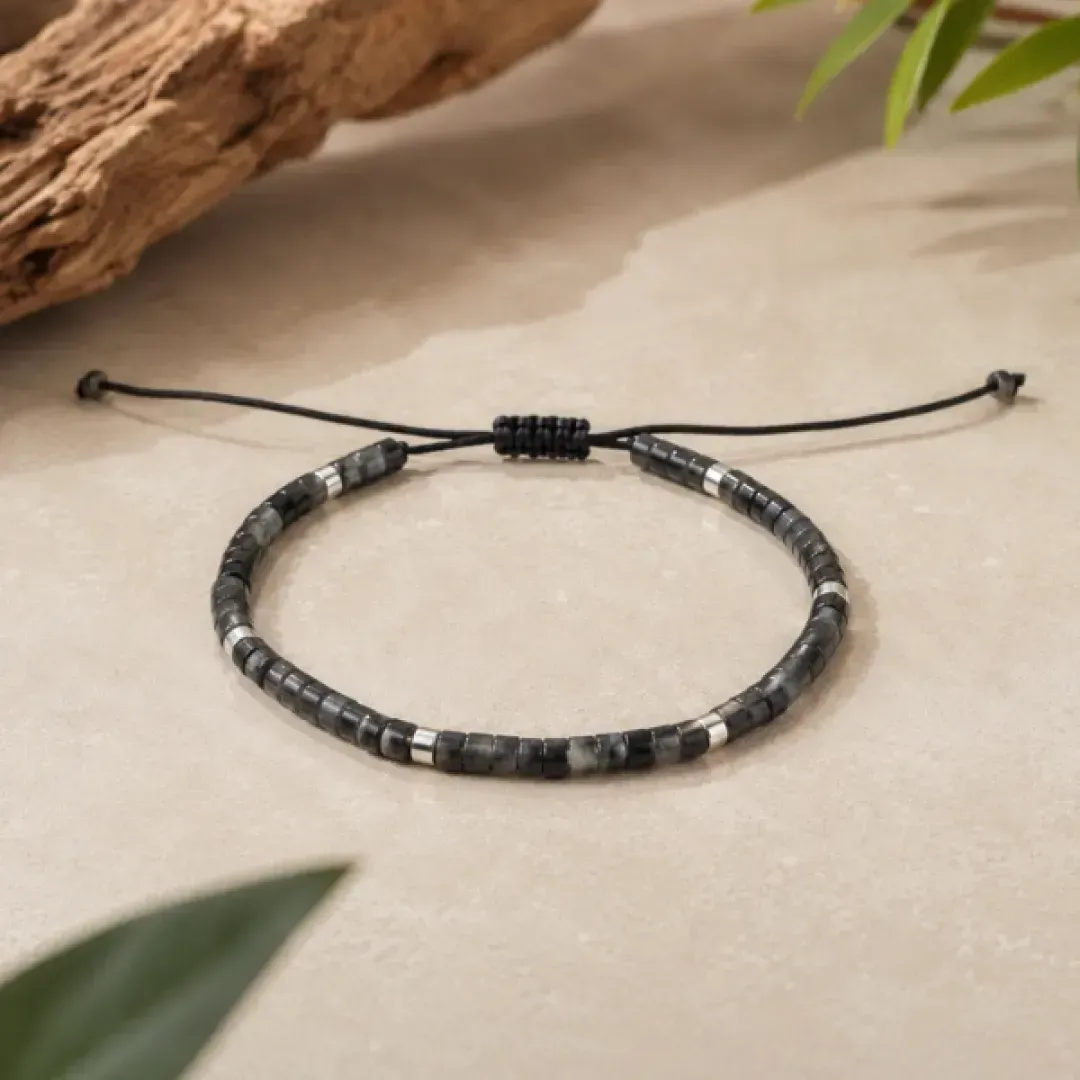
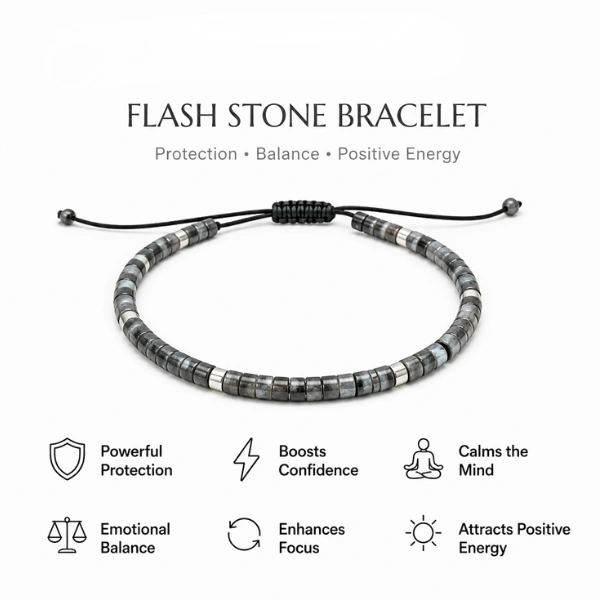
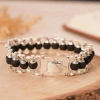
Pick it up and it looks dark grey. Quiet. Almost plain. You wonder for a moment why someone would pay Rs.1,500 for a grey bracelet.
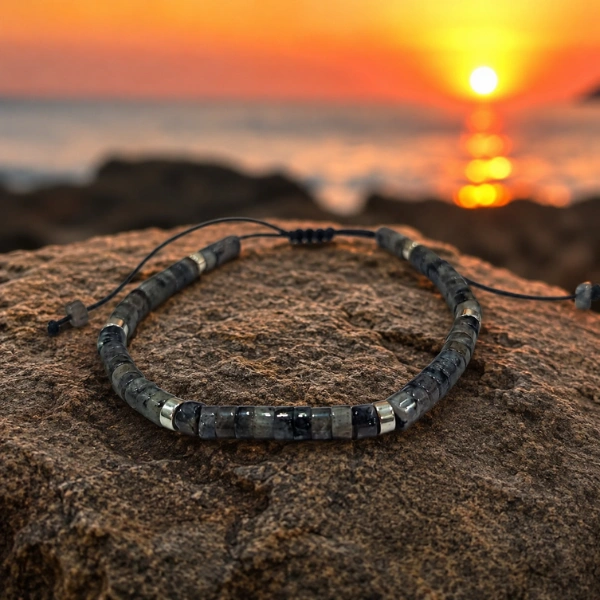
Then you tilt it toward the light.
And something happens that you were not prepared for. A flash of electric blue appears from deep within the stone — not on the surface, not a coating, not a shimmer — a burst of colour from inside the stone itself, appearing and shifting as you move your wrist. Some beads flash blue. Some go green-silver. Some stay dark and then suddenly light up as the angle changes.
It is alive in a way that most stones are not.
This is Labradorite. And what you are seeing has a name.
What Is Labradorescence — The Science of the Flash
Labradorite is a feldspar mineral, first discovered in 1770 in Labrador, Canada — which is where its name comes from. Geologically, it forms in igneous and metamorphic rocks, crystallising slowly over millions of years.
Inside the stone, there are layers — thin, alternating layers of mineral composition that formed at different temperatures during cooling. When light enters the stone, it travels through these layers. At each boundary between layers, some light reflects back and some continues through. The reflected light from multiple layers combines and interferes — and depending on the thickness and spacing of those layers, specific wavelengths of light emerge. Blue. Green. Gold. Violet.
This is called labradorescence — and it is entirely internal. It is not the surface of the stone shining. It is light physically bouncing between layers inside the stone and emerging through the surface.
No two pieces of labradorite flash the same colour or the same way — because no two pieces formed with identical layer spacing. The blue flash in your bracelet is specific to that piece of stone. That piece formed that way, in that location, over millions of years — and nothing else in the world will flash exactly like it.
This is what "flash stone" means. And this is why people who encounter labradorite for the first time stop and stare.
Labradorite Through the Centuries — The Aurora Stone
The Inuit people of Labrador, Canada — one of the first groups to live alongside this stone — had a legend about its origin. They believed the Northern Lights, the Aurora Borealis, had become trapped inside the stone long ago. That a warrior tried to free the lights by striking the rock — and some escaped into the sky, but the rest stayed inside the stone forever.
It is a beautiful story. And it is not entirely wrong — the labradorescence in the stone genuinely looks like a miniature aurora. Blues and greens and golds moving slowly as the stone is turned, just as the Northern Lights shift across the sky.
In Inuit shamanic tradition, labradorite was called the "stone of magic." Shamans used it in ceremonies to access deeper states of awareness, to read situations clearly, and to protect themselves while working in energetically intense conditions. The stone was believed to create a barrier — an energetic shield — that kept negative influences out while allowing the shaman to move freely within it.
This protective quality — the stone that shields without isolating, that keeps outside energy out without closing the wearer off from the world — is labradorite's most consistent cross-cultural attribution. From Canadian shamans to European gem traders to modern crystal practitioners, the same quality is described again and again.
What Labradorite Actually Does — Three Things, Honestly
In crystal tradition, labradorite is primarily associated with three qualities. Not ten. Not twenty. Three — and understanding each one specifically is more useful than a long list of vague benefits.
Protection of the aura. The aura — in Vedic and many traditional understandings — is the energetic field surrounding the body. In daily life, this field picks up the energy of the people and spaces around you. Difficult people, stressful environments, emotionally heavy conversations — all of these leave residue. Labradorite is consistently described as a stone that strengthens and seals the aura — creating a filter that reduces how much external energy penetrates your own field. If you leave conversations feeling drained, if certain people leave you exhausted, if environments affect your mood strongly — this is the stone most commonly recommended for that.
Intuition and inner knowing. Labradorite is associated with the Third Eye Chakra — Ajna — the center of intuition, inner vision and the ability to see situations clearly. Not logically, not emotionally, but with a quiet inner sense that simply knows. People who work in high-pressure decision-making roles, who need to read situations quickly, who want to trust their instincts more fully — labradorite supports exactly that capacity. It does not manufacture intuition. It reduces the noise that was drowning it out.
Transformation without losing yourself. This is the quality that makes labradorite specifically useful for people in the middle of significant change. Career transitions, relationship shifts, new cities, new chapters. Change is disorienting by nature — you do not yet know who you are in the new context. Labradorite's stabilising quality provides an anchor in that disorientation — it keeps the core of who you are intact while the external circumstances shift around it. You change, but you do not lose yourself in the changing.
Why Black Labradorite — Not the Typical Grey-Green
Most labradorite bracelets on the market use medium-grey labradorite that flashes blue-green on a relatively accessible stone. It is beautiful and genuine.
Black labradorite is darker — the base stone is a deeper, richer dark grey that approaches black. This darker base makes the flash more dramatic when it appears — the contrast between the dark stone and the sudden electric blue is sharper, more striking. The flash looks more like lightning against a night sky than shimmer against a grey background.
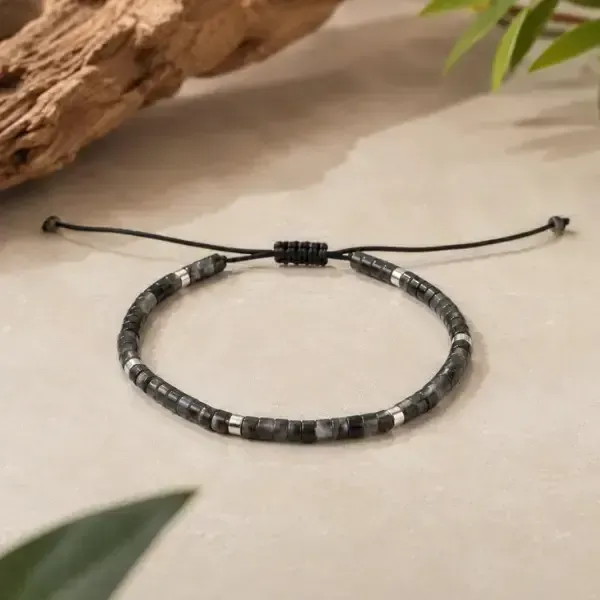
The darker stone also has a more serious, masculine quality that makes it genuinely wearable for men in a way that most crystal bracelets are not. The cube-cut beads — with their flat, architectural geometry — add to this quality. A black macrame cord completes the palette. Dark, minimal, considered.
This bracelet does not announce itself. It does not ask to be noticed. It simply is — until the light catches it. And then it is impossible to look away.
For Men Who Don't Usually Wear Crystal Bracelets
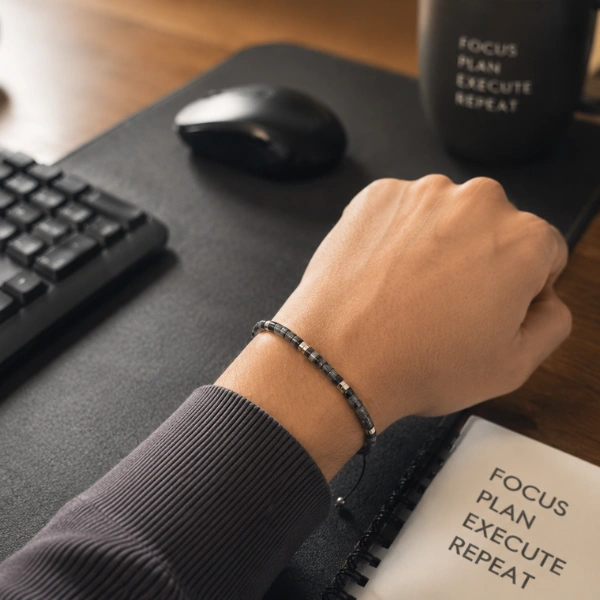
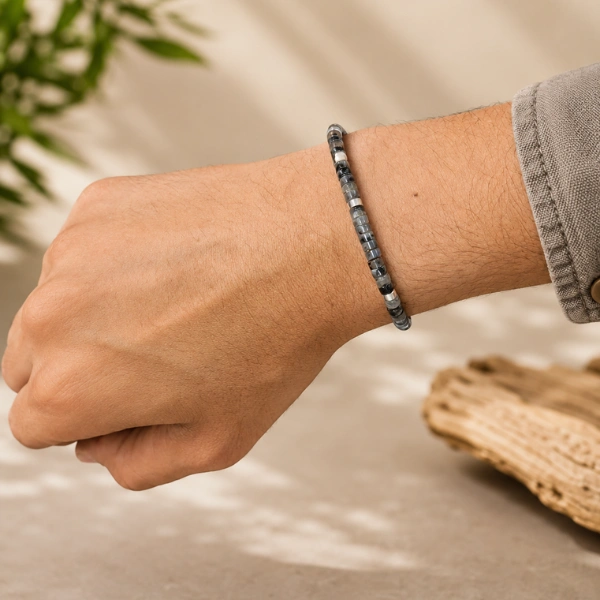
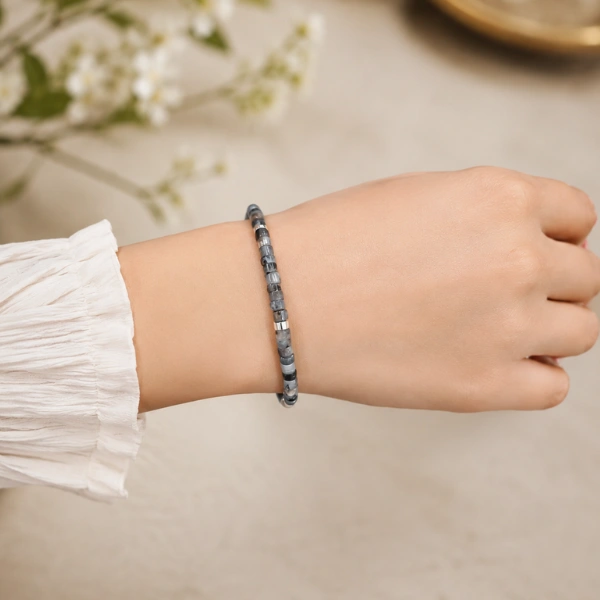
This bracelet works for anyone. But it is worth saying specifically: this is one of the few crystal bracelets that looks genuinely appropriate for men in professional, formal or casual settings.
Dark grey stone. Cube cut geometry. Black cord. No bright colours. No obvious spiritual symbolism. It reads as a considered, minimal accessory — jewellery with restraint. The kind of thing you notice on someone's wrist and ask about.
And when you find out it is labradorite — that it flashes blue when the light hits it, that it has been used by shamans for centuries, that it protects and grounds and builds intuition — it becomes something else entirely.
Explore the complete Bracelet collection at Suyagya for more crystal options. For a different energy alongside this one — the Hematite Bracelet pairs naturally with labradorite. Grounding plus protection. Earth and aurora.